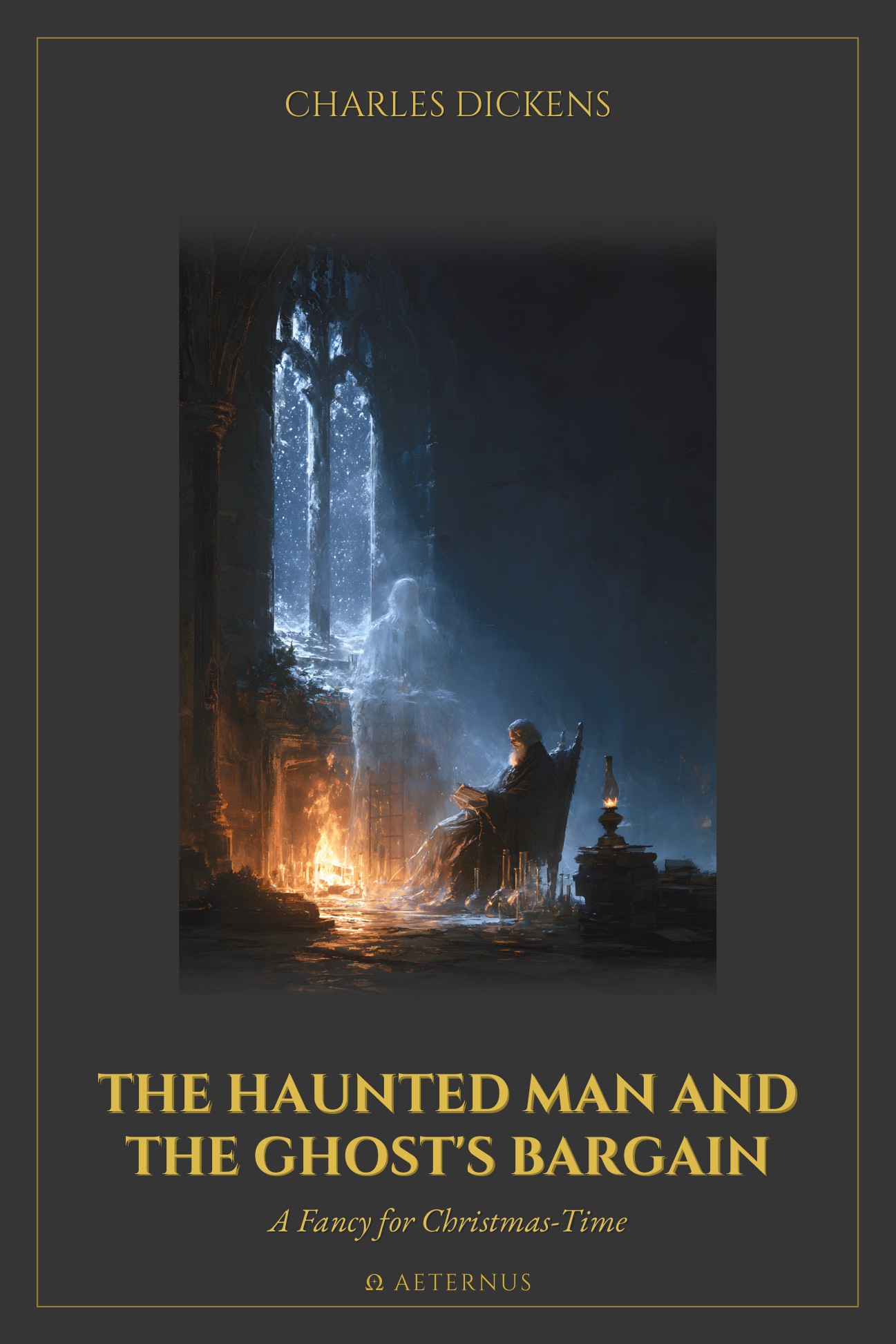
Anthracite Series
The Haunted Man and the Ghost's Bargain (Annotated)
On a winter evening, a figure with Redlaw’s own face offers to take away his memories of sorrow and wrong.
Forthcoming
Explore the edition →
Life and work
7.2.1812 – 9.6.1870
The crowded city and the solitary room.
A debtor’s prison, a newspaper office, a winter room lit by the fire: Dickens gives a place its own voices and movements. His fiction brings comedy, apprehension and human need into close company. In The Haunted Man, the most private wish sets a whole small world in motion.
Return to the editions ↓The Haunted Man and the Ghost’s Bargain, the last of the Christmas books, is in preparation at AETERNUS. Publication details will follow.
Anthracite Series
On a winter evening, a figure with Redlaw’s own face offers to take away his memories of sorrow and wrong.
Forthcoming
Explore the edition →Life and work
Dickens’s London contains people who scarcely seem to inhabit the same city: the secure and the precarious, the learned man alone with his books and the family making room for another child. His stories find the points at which those lives touch.
Charles John Huffam Dickens was born in Portsmouth in 1812. In 1824 his father was imprisoned for debt and Charles worked in a blacking factory. These are documented circumstances of his childhood; they do not explain every character he later created.
Legal-office work led to shorthand reporting and journalism. The sketches published under the name Boz and the Pickwick contract of 1836 opened another career in fiction. Public readings later made the author a performer before his readers; paid tours began in 1858.
Dickens died at Gad’s Hill Place in 1870 and was buried in Westminster Abbey.
The Christmas books bring a supernatural disturbance into everyday rooms and streets. A Christmas Carol appeared in 1843. The Haunted Man, published in 1848, closes that sequence with the chemist Redlaw and a gift whose consequences spread beyond its recipient.
The three chapters move between Redlaw’s isolation, the crowded Tetterby household and Milly Swidger’s visits to the sick and lonely. Their contrasting voices give the story its scale. The question of memory becomes a question about the attention one person can give another.
The force of these scenes lies in their particularity: a repeated phrase, a baby too heavy for the child carrying it, a seat beside the fire. Dickens makes an argument through the people who must live with its consequences.