Green Series
The Discovery of the North-West Passage (Annotated)
The 1856 account of HMS Investigator and the first recorded traverse of a North-West Passage, with historical illustrations and a folding chart.
Forthcoming
Explore the edition →
Life and work
1807–1873
Vice-Admiral, Royal Navy (1873)
From the Bering Strait to Mercy Bay.
Robert McClure took HMS Investigator into the Arctic from the Pacific in search of Franklin. The ice held his ship at Mercy Bay. To finish the crossing, his men left the ship and went on over the ice.
Return to the editions ↓The AETERNUS edition presents the 1856 text with historical illustrations and the folding chart. The full-resolution chart is available below.
Green Series
The 1856 account of HMS Investigator and the first recorded traverse of a North-West Passage, with historical illustrations and a folding chart.
Forthcoming
Explore the edition →EXPEDITION CHART
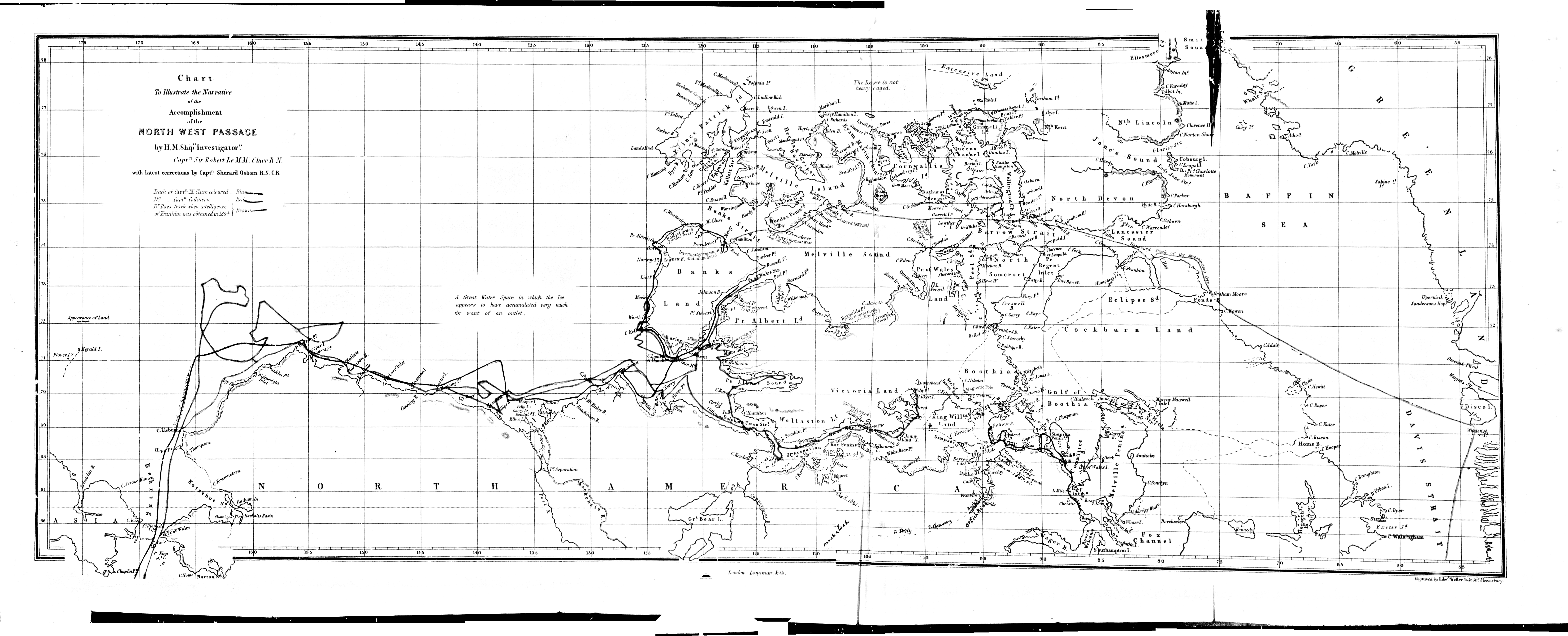
Follow the route of HMS Investigator on the chart accompanying the 1856 narrative.
Full-resolution 600 ppi PNG.
Download PNG ↓Life and work
The voyage began as a search for missing men. It became a test of whether a crew could survive long enough to pass from one ocean to the other.
Born in Wexford in 1807, McClure entered the Royal Navy in 1824. He first sailed into Arctic waters aboard HMS Terror in 1836.
In 1850 he sailed westward in HMS Investigator. From Prince of Wales Strait, he established the connection with waters already charted from the east. The ship later became trapped at Mercy Bay. A party from HMS Resolute reached the crew in 1853, and the men returned to Britain in 1854.
McClure later served in China. He was made a Companion of the Order of the Bath in 1859 and became a vice-admiral on the retired list in 1873.
Sherard Osborn shaped McClure’s journals into the account published in 1856. Its changes of pace follow the work of the expedition, from sounding and charting new waters to rationing supplies while the ship lay still.
The expedition completed the first recorded traverse of a North-West Passage. Its course is best followed in stages, from the Pacific approach to the journey across the ice and the return through eastern Arctic waters.