Green · Military, expeditions and frontiers
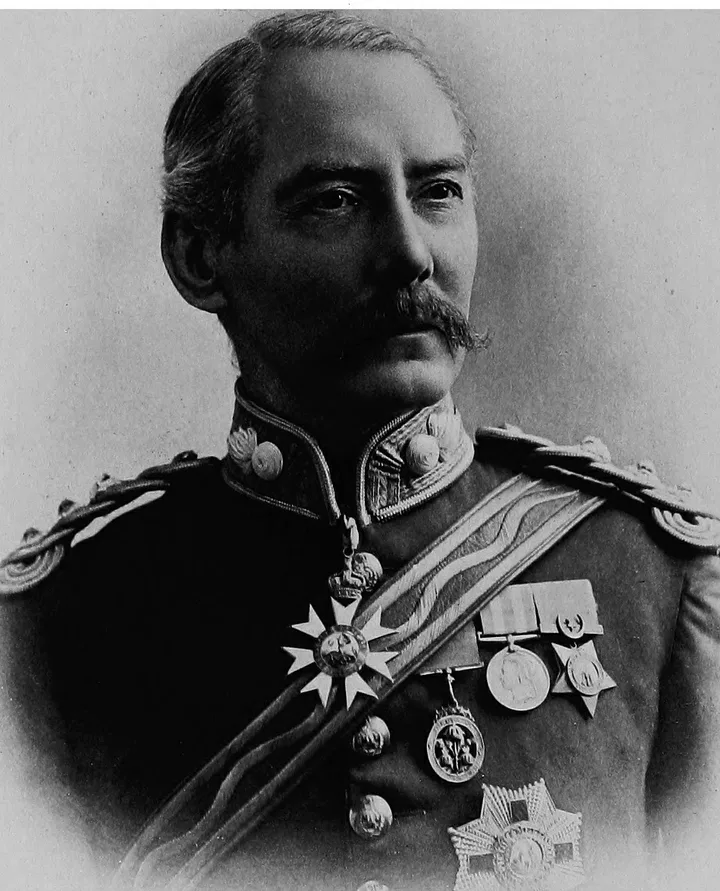
Sir Charles William Wilson
1836–1905
He reached Khartoum forty-eight hours too late.
Royal Engineer, surveyor of Jerusalem and Chief of Intelligence of the Nile Expedition, Wilson crossed the Bayuda with the Desert Column, took command when Sir Herbert Stewart was mortally wounded, and boarded Gordon’s armed steamers for the last ascent. From Korti to Khartum (1885) is his own record of that march.
English-language editions
 ↗
↗GREEN
Sir Charles William Wilson
Sudan, 1885. Khartoum is besieged and time is running out. Across the Bayuda Desert the British Desert Column drives towards the Nile in a desperate attempt to reach General Gordon. Among its officers is Sir Charles William Wilson, Royal Engineer, intelligence chief and, after the mortal wounding of Sir Herbert Stewart, commander in the field.
Explore the edition →Life & context
Engineer and surveyor
Born at Liverpool on 14 March 1836, Wilson entered the Royal Engineers at nineteen. In 1858 he became secretary to the British Boundary Commission surveying the forty-ninth parallel between the Rocky Mountains and the Pacific, where surveying itself became expeditionary work against distance.
In 1864–1865 he commanded the Royal Engineers party responsible for the Ordnance Survey of Jerusalem, work that transformed the modern cartography of the city and placed British geographical investigation in Palestine on a scientific footing.
Intelligence and diplomacy
After returning to Britain he served in the Topographical Department of the War Office and later in the Intelligence Department as Assistant Quartermaster-General, organising the geographical and political knowledge on which British military planning increasingly depended.
Special missions and boundary commissions in the Balkans and the Ottoman Empire followed; from 1879 to 1882 he was British Consul-General in Anatolia. When Britain intervened in Egypt in 1882 he accompanied Sir Garnet Wolseley’s expedition.
The Desert Column
Wilson joined the Nile Expedition of 1884–1885 as Chief of Intelligence and went with the Desert Column across the Bayuda. At Abu Klea on 17 January 1885 the British square was penetrated and closed again; two days later, near Abu Kru, Sir Herbert Stewart was mortally wounded and command passed without warning to Wilson, with some fourteen hundred exhausted men still short of the Nile.
He brought the column to the river at Gubat, then went upstream himself aboard the steamers Bordein and Talahawiyeh, four days under rifle and artillery fire. On the afternoon of 28 January Khartoum came into view. The Mahdist banners stood over the city; it had fallen in the early hours of 26 January, and Gordon was dead.
