ANTHRACITE SERIES · AETERNUS
William Gilmore Simms
1806–1870
Novelist of the Southern Border
English-language editions
 ↗
↗Anthracite Series
William Gilmore Simms
Along the southern frontier, an old alliance is breaking apart. Trade, debt, settlement and the surrender of land have driven relations between the English colony and the Yamasee toward war. Beyond the scattered plantations and blockhouses lie forests in which rumor, diplomacy and violence move faster than authority.
Explore the edition →Life & context
About the Author
William Gilmore Simms was born in Charleston, South Carolina, on April 17, 1806, into circumstances that offered little promise of the immense literary career to come. His mother died while he was an infant, and his father soon left Charleston for the West. Simms remained behind in the care of his grandmother, whose stories of Revolutionary Charleston and family experience supplied one of his earliest connections to the historical memory that would later dominate his fiction. His formal education was limited, but his reading was voracious; history, local tradition and travel furnished much of the material that formal schooling had not.
He studied law, was admitted to the bar and briefly moved through the professional expectations of a young Charlestonian, yet literature had already taken command of him. In the 1820s he founded and edited literary journals, published poetry and entered newspaper work. By 1829 he had become editor of the City Gazette.
Then came a succession of personal and financial blows. His father and grandmother died. His house burned. His first wife died in 1832. His newspaper failed, leaving him nearly penniless. Rather than withdraw from letters, Simms made the decision upon which the rest of his life would rest: he would become a professional American writer.
The result was astonishing productivity. Martin Faber appeared in 1833, followed by Guy Rivers in 1834, The Yemassee and The Partisan in 1835. These works established Simms rapidly in the literary world of New York and Charleston and demonstrated that the southern frontier, Carolina history and the American border could sustain large-scale romance.
Simms wrote novels, poetry, biographies, history, journalism, criticism and short fiction. He edited magazines and newspapers, lectured, carried on an enormous correspondence and assembled one of the notable private historical libraries of the South. His central literary territory, however, remained the American South. He returned again and again to Carolina because he regarded place not as a limitation upon literature but as its necessary foundation. Colonial settlements, Revolutionary partisans, swamps, coastal rivers, backcountry roads and border warfare supplied him with the materials from which a national literature could be built.
He thought of the romance in large terms. For Simms, it stood nearer epic than domestic fiction. History provided the great movement; individual lives entered that movement and were enlarged by it. The result can be seen across his Carolina novels, from the colonial world of The Yemassee through the Revolutionary cycle of The Partisan, Mellichampe, Katharine Walton, The Forayers, Eutaw and Woodcraft. His fiction attempts to cover the broad sweep of Carolina history, from early settlement through Revolution and into the emerging American character.
No work represents that ambition more powerfully than The Yemassee. Simms wrote most of it in the second half of 1834, describing the project in correspondence as an Indian tale concerned with early Carolina settlement and an old Native nation. It appeared in April 1835 as The Yemassee: A Romance of Carolina. Its rapid success fixed his reputation.
But the larger importance of the novel lies in the confidence with which Simms claimed an American subject upon American ground. He did not borrow a European ruin. He entered the Carolina forest. He found there war, loyalty, ambition, prophecy, family, betrayal, political calculation, terror and tragedy enough for any romance.
Simms died in Charleston on June 11, 1870, after a literary life of extraordinary range and endurance. The Civil War had devastated much of the world in which he had lived; his beloved Woodlands was burned, and with it a library accumulated over decades. Yet the historical landscapes he had committed to fiction survived in another form. Among them, The Yemassee remains the great early monument.
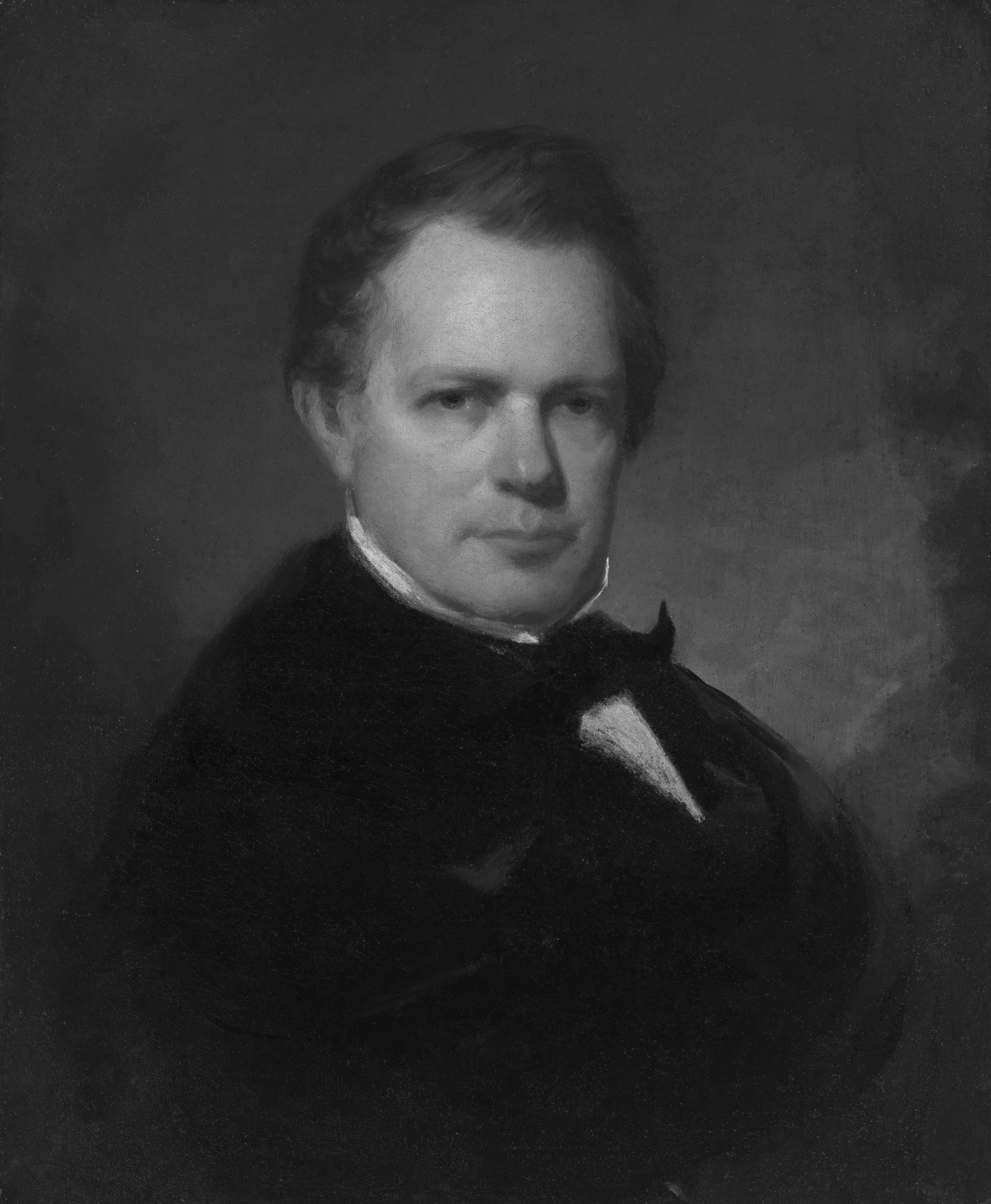
Oil on canvas, unidentified artist. National Portrait Gallery, Smithsonian Institution.
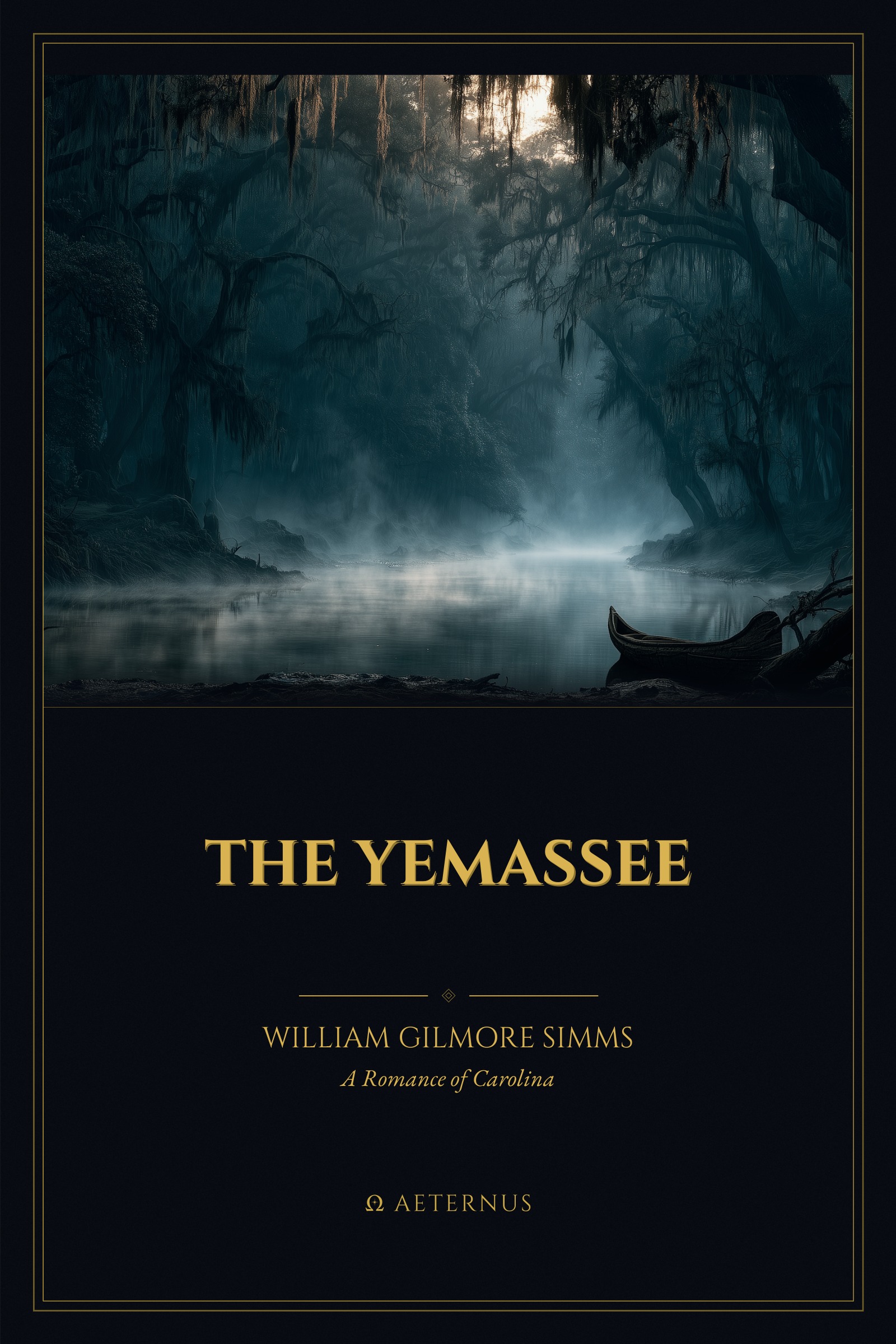
The Yemassee
A Romance of Carolina
Forthcoming
“Above any romance of native production on a native subject.”
American Monthly Magazine, 1835
Carolina, 1715.
Along the southern frontier, an old alliance is breaking apart. Trade, debt, settlement and the surrender of land have driven relations between the English colony and the Yamasee toward war. Beyond the scattered plantations and blockhouses lie forests in which rumor, diplomacy and violence move faster than authority.
At the center stands Sanutee, a Yamasee chief determined that his people shall not yield the ground upon which their identity rests. Yet the fracture has already entered his own house: his son Occonestoga has been drawn toward the English world, while Matiwan, wife and mother, is caught between the claims of blood, nation and duty.
Published by Harper & Brothers in 1835, William Gilmore Simms’s The Yemassee transformed one of the gravest conflicts of colonial Carolina into a sweeping American historical romance. The first edition sold rapidly enough to require an almost immediate second printing, establishing Simms as one of the prominent literary voices of his generation.
Here the American forest becomes what the castle had been to European romance: a place of danger, secrecy, loyalty, war and fate.
Simms called his purpose “the natural romance of our country.”
The Yemassee was one of its great early monuments.
Inside this edition
- Complete text of the first edition of 1835, checked line by line
- Five plates made for this edition
- Publisher’s foreword, historical note and closing essay
- Glossary of historical and literary terms
- Author biography and editorial note
